
Kiwanis Club of Bowling Green, KY History
1920's
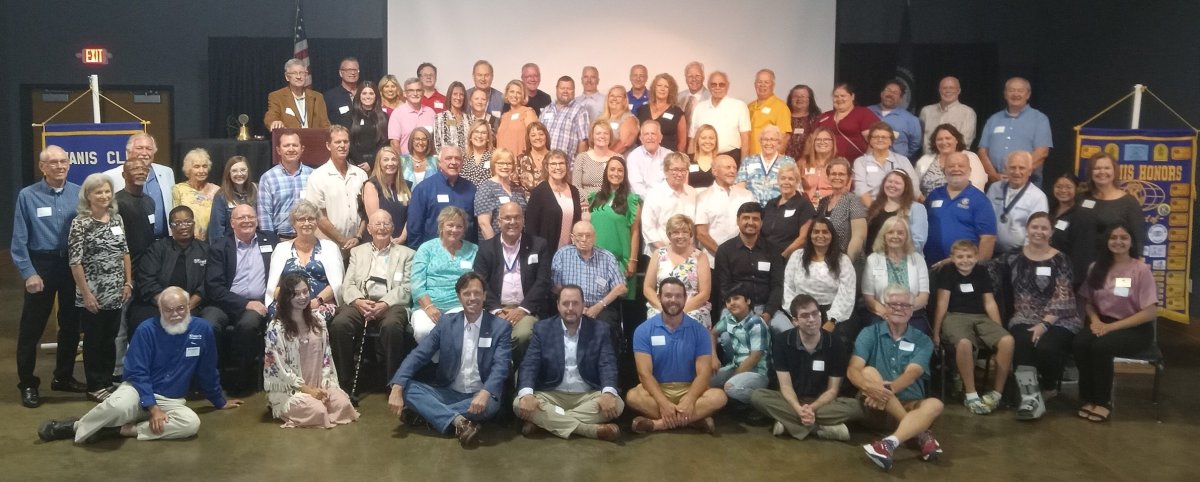
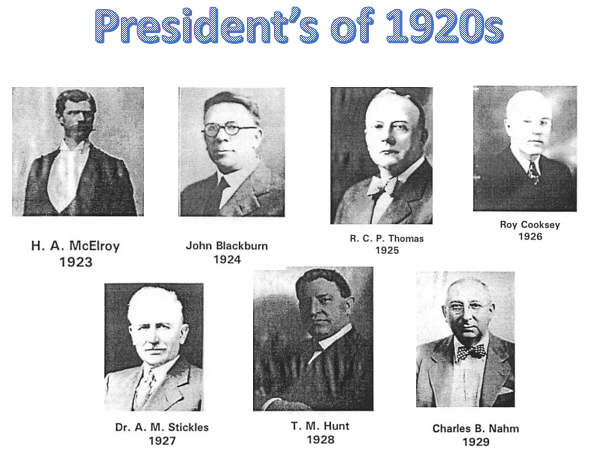
Our stroll begins in the early 1920s, when men are wearing suits and fedoras, and women are wearing straight, loose dresses and head-covering helmet hats made of felt. Transportation consists of horses, boats, trains, or automobiles, although a truck lovingly called Ol’ Green hasn’t yet been thought of, and 31-W is just being paved. In the spring of 1922, a little boy named Hayward Minton is born in Butler County. In Bowling Green, the construction of Helm Hotel is announced; Service One Credit Union is chartered; the L&N Depot is built; and on July 24, 1923, with 51 members the Kiwanis Club of Bowling Green is chartered. I have no way of confirming this, but I suspect those men knew they wanted to improve their community, but did not know, nor could they imagine, the impact that act would make. What we do know is that in its first decade, the Kiwanis Club helped to secure land for an airport for Bowling Green and Warren County that years later would be the site of an event called Thunderfest. In addition, our forefathers hosted events for local farmers and for the Boys Club.
1930's
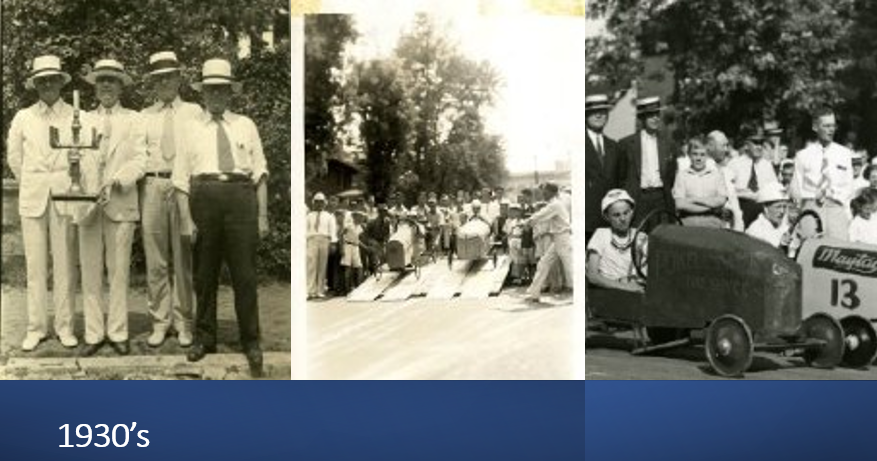
As we arrive in the 1930s, women are wearing dresses with wide shoulders and puffy sleeves with ruffles, buttons and bows. Men’s suits consist of high waisted trousers with creases and turned up cuffs, or bib overalls for labor. Nationally, we are living through the Great Depression and listening to big band and swing music. Frozen food is invented; the first Masters golf tournament is held; the Star Spangled Banner is adopted as our National Anthem; and World War II has started overseas. Closer to home, Graves Gilbert Clinic is opened; and Lost River Cave is a night club! The Kiwanis Club was active, installing two road signs at approaches to Bowling Green, raising $300 by presenting the play Green Pastures, distributing Christmas baskets to needy families, and hosting 20 boys in the Kiwanis Club 1938 Soap Box Derby.
1940's
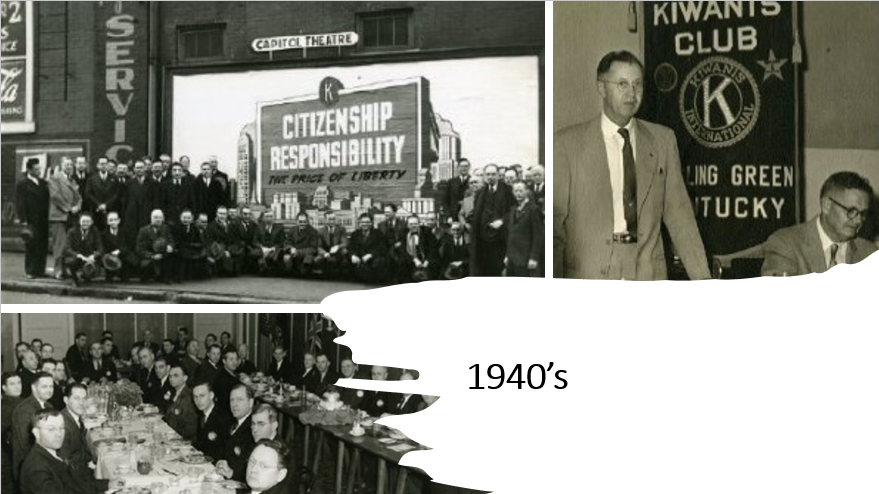
The Japanese bomb Pearl Harbor on December 7th, 1941; Western Kentucky State Normal School becomes Western Kentucky State College; Charlie Garvin buys Beech Bend at auction and the first motorcycle race is held on a dirt track at Beech Bend Raceway; the Union Underwear plant is completed; the 31-W By-Pass is opened and Pauline Tabor’s home on Clay Street is in its “heyday”. Welcome to the 1940s!! Our Kiwanis Club is commended by the United States Treasury for selling war bonds to aid in the war effort, and our first Key Club is organized at Bowling Green High School with 29 initial members.
1950's
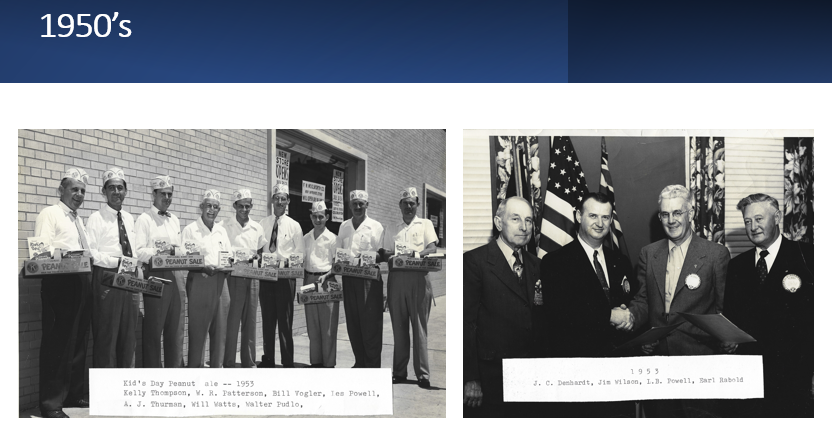
As we enter the 1950s, women are wearing dresses with full skirts and two-toned saddle shoes. Professional men are wearing baggy suits with skinny ties, while younger men sport jeans, white tee-shirts, leather jackets, and greased-back hair. Bowling Green, like the rest of the United States is experiencing an improved economy, however it is also starting to be known as Little Chicago. Kiwanian William H Natcher is elected to the United States House of Representatives in 1953. We see that Kiwanis is holding its meetings at the Helm Hotel and is busy with a radio auction to benefit the March of Dimes, selling peanuts and contributing funds to the hospital for the benefit of underprivileged children.
1960's
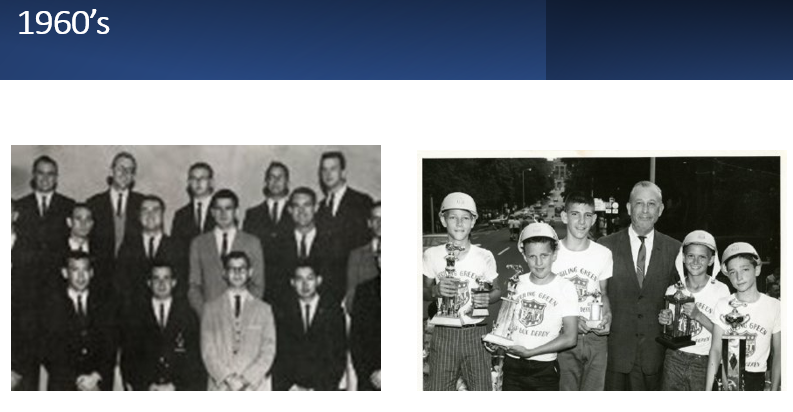
Moving into the 1960s, our country is experiencing the Cuban Missile Crisis, the assassinations of President John F Kennedy and Martin Luther King, the Vietnam War, the Civil Rights movement, and the first man landing on the moon. The term “hippie” is heard for the first time, and bell bottom jeans, tie-dyed shirts, long hair and beards are common attire. Closer to home, Western Kentucky State College becomes Western Kentucky University in 1966 with Dr. Kelley Thompson, Kiwanian, as President. Coach Diddle coaches his last game in 1964 after a 40-year career; Camping World is started; and sadly, residents of Jonesville are displaced as part of eminent domain. Kiwanis improves its roster with the addition of Hayward Minton as a member on March 31, 1960. We’re selling peanuts and hosting the Soap Box Derby, and we have a Circle K Club at Western. That new member Hayward is still a member of this club at 102 years young and with 64 years of perfect attendance.
1970's
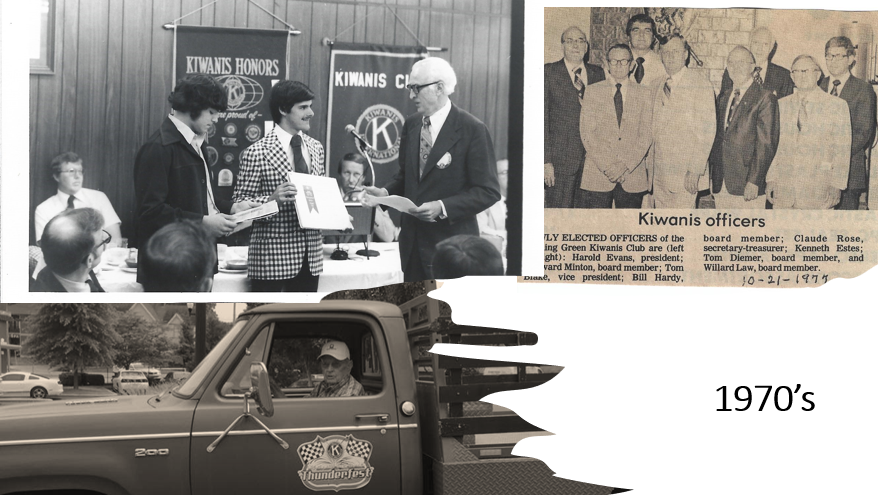
The 1970s saw the end of the Viet Nam war, Watergate, the resignation of President Richard Nixon, the movie Jaws and the song Sweet Home Alabama, the founding of Microsoft and Apple, and the manufacture of a 1973 Dodge truck named Ol’ Green. The Kiwanis Club decided to hold its first fireworks show ever at Smith Stadium on Western’s campus with its first chairman being Hayward Minton, who just happened to be Ol’ Green’s person. The 70s was a really good decade for the Bowling Green Kiwanis Club!
1980's
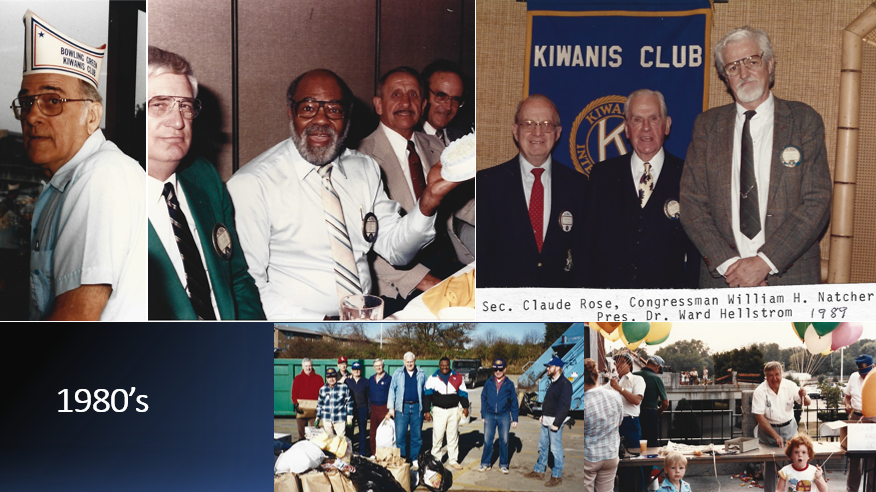
Here we are at the 80s! Women are wearing brightly colored exercise tights and leg warmers with their hair permed, teased and sprayed as high as they could get it! Chrysler introduced the first mini-van; MTV and CNN began broadcasting; and roller blades and Rubic Cubes were introduced. Locally, the Corvette plant opened. Kiwanis inducted its first female, Betty Biggerstaff, into the club in 1987. From everything I can find, she did not wear exercise tights or leg warmers to meetings! Hayward has stated he did not vote yes for letting women in the club but has since decided he was wrong! Kiwanis sponsored a Bowl-a-Thon, parked cars at a Rodeo, rang Salvation Army Bells and started a recycling project.
1990's
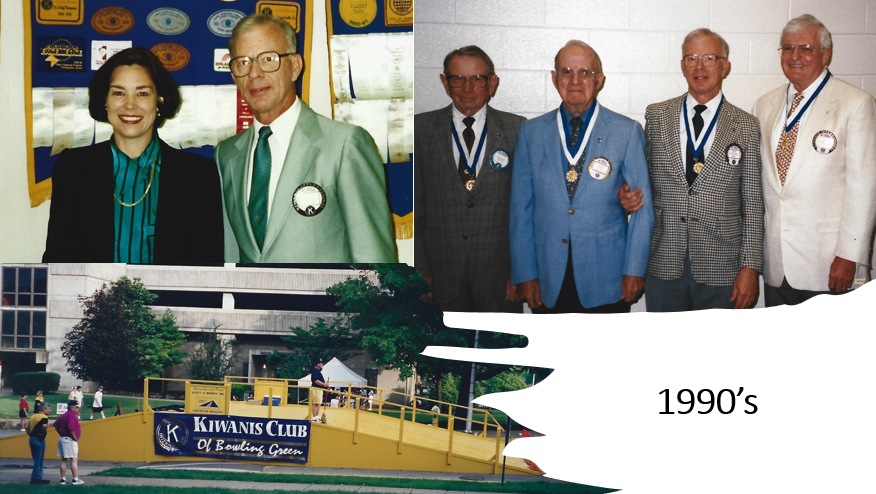
Our memory path continues to the 90s. Nationally, the world wide web is introduced, the Gulf War is being fought, OJ Simpson is trialed for the murder of his wife and her friend; and the Olympics are held in Atlanta. Bowling Green experiences a massive hailstorm affecting most of its residents. Ol’ Green survived, but many cars did not. Kiwanis International partnered with UNICEF to end the Iodine Deficiency Disorder, and the Bowling Green Kiwanis Club was very active in that initiative. In addition, thanks to David Holland, Roger LaPointe, Kevin Laughlin and Brent Brennenstuhl, the Soap Box Derby was revived in 1998 and held on Western’s campus. We sponsored the first Stand for Children Day, an event that 27 years later is still going strong. Happy Dollars were introduced by Beaver Simpson, a Christmas tree recycling project was started, fireworks are continuing, now at the Corvette Museum, and Valerie Brown was elected as the first female President.
2000's
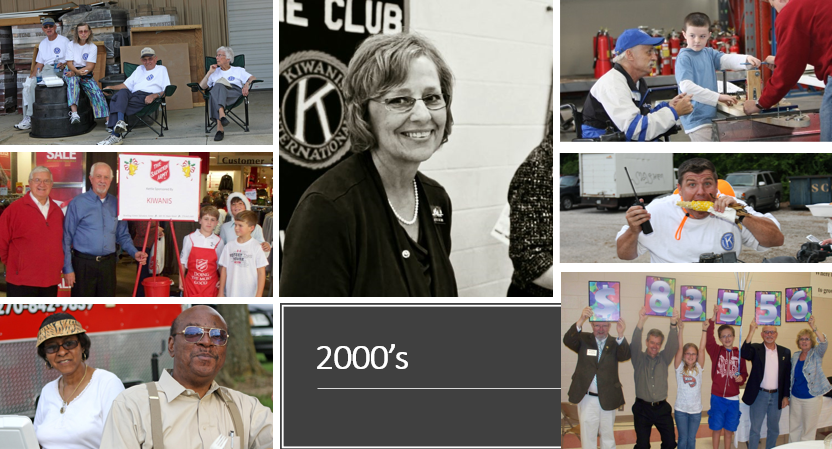
Whoa…we’re at Y2K and we’re all afraid the world is going to end! It didn’t, but the world as we knew it almost did on September 11, 2001. In fashion, Jennifer Lopez wore a dress cut “down to there” but fortunately that fashion style didn’t catch on in Bowling Green. What did catch on was the Eliminate project, another partnership between Kiwanis International and UNICEF. Led by Dr. Bill Harrigan and assisted by Sue Fleschner, our club raised over $110,000. This amount was raised over and above our normal fundraisers, without cutting funding or services to our local non-profits. Soap Box Derby moved from WKU to our own track at Phil Moore Park.
2010's
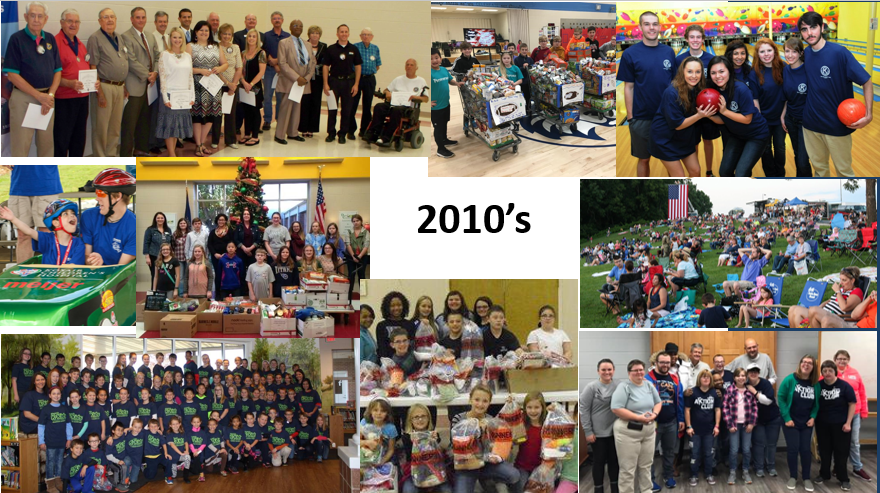
By 2010, the Soap Box Derby had grown to the world’s largest race and Thunderfest was listed in the country’s top 15 Fireworks Shows. In addition to those projects, we continued with Stand for Children, providing food baskets at Christmas, ringing Salvation Army bells, and volunteering at the Polar Express. The Club established Service Leadership Programs (SLP): Briarwood Elementary K-Kids, Drakes Creek Builders Club, Greenwood HS Key Club, South Warren Key Club, and the Aktion Club. I do want to note that in 2014 a sinkhole opened up right here at the Corvette Museum, swallowing several very expensive Corvettes, but our fireworks were cleared of any wrong-doing. Also, I need to note that Ol’ Green survived the sink hole. For that matter, Ol’ Green has survived everything!!
2020's
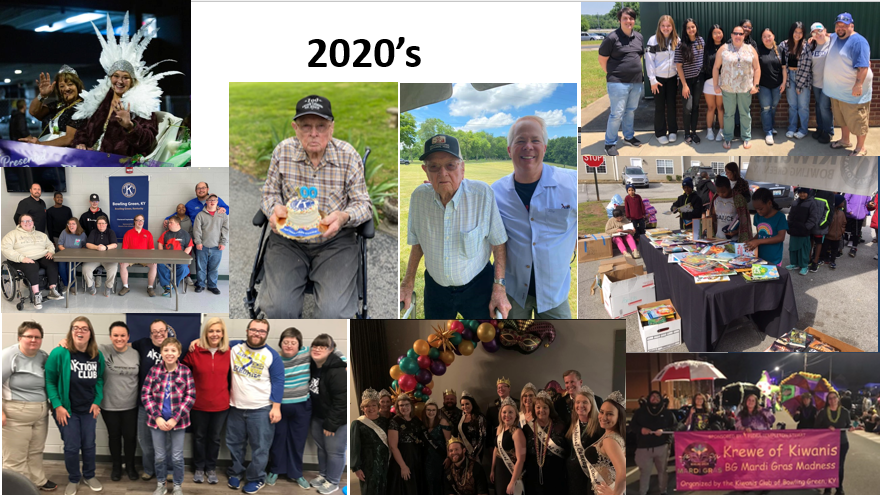
Our current decade started with our country shutting down three months in due to Covid. Our eldest member Hayward, who at that time was 99, was the member who wanted to meet in person more than anyone else! We were concerned that not meeting in person would slow our momentum, but it didn’t! In just the last few years, new projects like Mardi Gras Madness created by Flora T Stuart, Leeann Darling, Jessie Reece and Cornhole for a Cause led by Anthony LaPointe were added!
Kiwanis Today!
That brings us to the end of our reflective walk down memory lane. Our history is rich and firm. While we have held firm to our foundation, we have also embraced change, a fact that I think has allowed us to evolve, grow and thrive and I think speaks to the leadership this club has had over the years. So……what do we do now? Do we just applaud ourselves tonight and go home? Of course not. All this history means nothing if we don’t use it as a steppingstone into the future. As we look to the to the future, we see that we are presently 126 members strong, the largest this club has ever been! Our members are caring, energetic, creative individuals who are willing to share their talent and time to continue the mission of improving the lives of children here and around the world. Our members are beacons of light for this community, and as we commemorate our past, I am convinced that the future of the Kiwanis Club of Bowling Green is gloriously bright.